Submissions
Author Guidelines
How to Register and Submit a manuscript at CAPEU JOURNAL OF EDUCATION
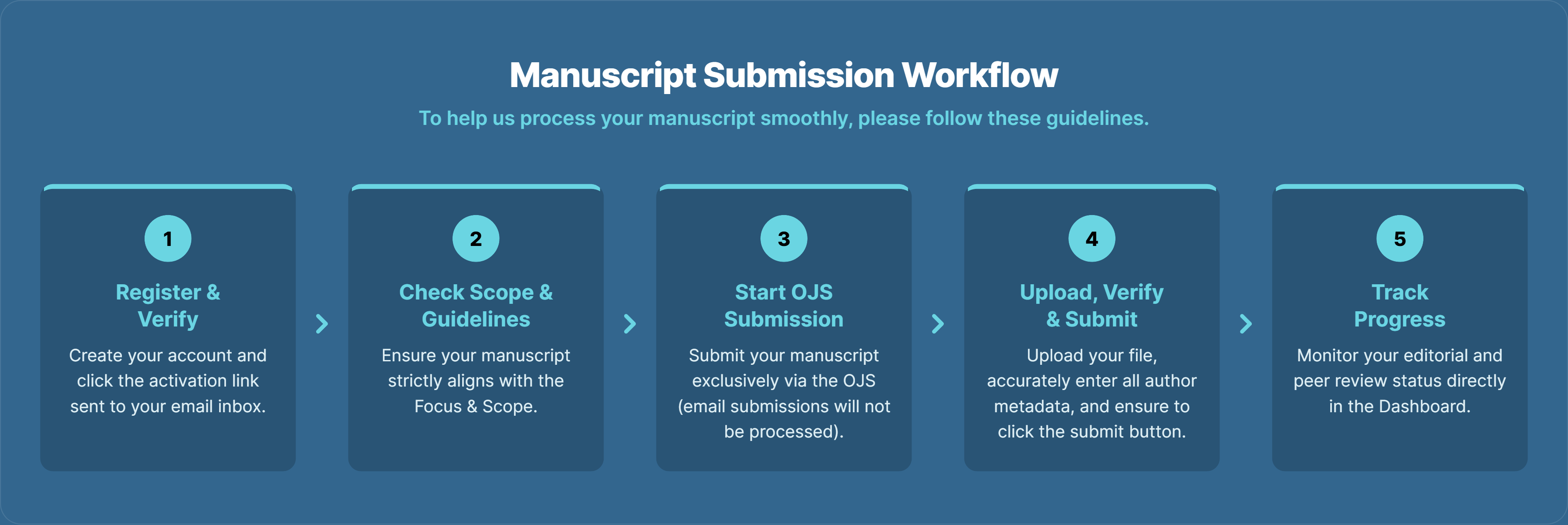 PART 1: Registering as an Author
Step 1 Navigate to Registration
Go to the journal's homepage and click the Register button located in the sidebar or top navigation menu.
Step 2 Fill in Profile Information
Complete the form with your personal details. Fields marked with an asterisk (*) are mandatory.
- Given Name: Your first name.
- Family Name: Your last name/surname.
- Affiliation: Your university or institution name.
- Country: Select your country.
- Login Details: Enter a valid Email, create a Username, and set a strong Password.
Image
Step 3 Complete Registration & Verify
At the bottom of the form, check the box confirming you agree to the privacy statement, then click Register. Note: Check your email inbox and click an activation link before you can log in.
PART 2: Submitting an Article
Step 1 Start Submission
From your author dashboard, click the New Submission button.
- Select the appropriate Section (e.g., Articles).
- Carefully read and check all the boxes under Submission Requirements.
- Add any Comments for the Editor, agree to the privacy statement, and click Save and continue.
Image
Step 2 Upload Submission File
A window will pop up for your file upload. (Note: All files, including datasets or images, are uploaded here).
- You must select an Article Component (e.g., Article Text) before the system will allow the upload.
- Upload your manuscript file from your computer.
- Click Continue, review the details, and click Complete.
Image
Step 3 Enter Metadata
Accurately fill in your manuscript's metadata to ensure proper indexing.
- Enter the precise Title, Subtitle (if applicable), and paste your Abstract.
- To add co-authors, click Add Contributor and fill in their exact details.
- Enter Keywords one by one, pressing Enter after each.
- Paste your complete, formatted list of References, then save.
Image
Step 4 Confirmation
Review all entered information. If everything is correct, click the Finish Submission button. A pop-up will ask for final confirmation—click OK.
Image
Step 5 Next Steps
Your submission is complete! You will arrive at the Next Steps screen. From here, you can return to your dashboard to track your article's review status.
Image
PART 3: Author Guidelines & Manuscript Types
General Submission Guidelines
Before submitting, please ensure your manuscript complies with the following general formatting rules:
- Language: English (American or British standard, used consistently).
- Document Format: Microsoft Word (.doc or .docx).
- Font & Spacing: Times New Roman, 12-point font, 1.5 spacing throughout (including abstracts, blockquotes, and references).
- Anonymization: For double-blind peer review, please ensure the main manuscript file does not contain author names or affiliations. Submit a separate Title Page containing author details.
- Reference Style: Publication Manual of the American Psychological Association (APA), 7th Edition.
- Originality: Manuscripts must not be under consideration elsewhere. Similarity checks will be performed upon submission.
Manuscript Categories
1. Conceptual Paper
Conceptual papers focus on developing new theoretical frameworks, critiquing existing models, or synthesizing literature to offer novel perspectives. They do not typically involve new empirical data collection.
LENGTH 4,000 – 7,000 words (including references).
ABSTRACT 150–250 words. Must state theoretical purpose, proposed framework, and implications. Include 3–5 keywords.
Structure Requirements:
- Introduction: Establish context and background. State objective and significance to Asia-Pacific education.
- Theoretical Framework: Present the conceptual model. Define key terms. Use of diagrams/figures is encouraged.
- Literature Engagement: Synthesize recent literature (last 5 years). Explain how the framework builds upon existing theories.
- Discussion & Implications: Detail the impact on theory, research, and practice. Acknowledge constraints.
- Conclusion: Summarize theoretical contributions and emphasize the new perspective's importance.
2. Research-Based Paper
Research-based papers present original empirical research (quantitative, qualitative, or mixed-methods) that contributes to the advancement of educational practice or policy.
LENGTH 5,000 – 8,000 words (including tables, figures, references).
ABSTRACT 150–250 words covering background, objective, methodology, key findings, and conclusion. Include 3–5 keywords.
Structure Requirements (IMRaD Format):
- Introduction: Outline background, problem statement, literature review, and specific research questions/hypotheses.
- Methodology: Detail research design, sample, instruments, procedures, and data analysis. Explicitly state ethical considerations.
- Results/Findings: Present data clearly. Use tables/figures judiciously to support (not duplicate) text.
- Discussion: Interpret findings in relation to literature and research questions. Discuss practical/theoretical implications.
- Conclusion: Summarize core findings, acknowledge limitations, and recommend future research directions.
3. Best Practice (Practitioner-focused)
Best Practice papers highlight successful, innovative interventions, teaching strategies, or administrative implementations. These papers prioritize actionable insights over heavy theoretical exposition.
LENGTH 3,000 – 5,000 words.
ABSTRACT 150–200 words summarizing context, intervention, and outcomes. Include 3–5 keywords.
Structure Requirements:
- Context and Rationale: Describe the specific educational setting, the challenge faced, and the rationale for the intervention.
- Implementation: Provide a detailed, step-by-step account of execution, resources needed, and personnel involved.
- Outcomes and Evaluation: Share results and how success was measured (qualitative or quantitative evidence).
- Reflections and Lessons Learned: Discuss what worked, what didn't, and adjustments made.
- Conclusion and Transferability: Summarize the value and recommend how other Asia-Pacific institutions might apply this.
4. Book Review
Book reviews offer critical evaluations of recently published books (typically within the last 3 years) that are highly relevant to the scope of CAPEU.
LENGTH 1,000 – 1,500 words.
TITLE FORMAT Must be the full bibliographic citation (Author/Editor, Publication Year, Title, Publisher, Page count, ISBN).
Structure Requirements:
- Introduction: Introduce the book, author(s), core theme, and target audience.
- Summary of Contents: Provide a concise overview of structure and arguments (do not simply list chapters).
- Critical Evaluation: Discuss strengths, weaknesses, field contribution, and argument support. (Most important section).
- Conclusion: Offer a final verdict and recommend who would benefit most from reading it.
Submission Preparation Checklist
All submissions must meet the following requirements.
- This submission meets the requirements outlined in the Author Guidelines.
- This submission has not been previously published, nor is it before another journal for consideration.
- All references have been checked for accuracy and completeness.
- All tables and figures have been numbered and labeled.
- Permission has been obtained to publish all photos, datasets and other material provided with this submission.
Articles
Section default policyPrivacy Statement
The names and email addresses entered in this journal site will be used exclusively for the stated purposes of this journal and will not be made available for any other purpose or to any other party.